This is an interview with Zhang Xiangyu, a long-time research scientist. This is not a traditional peer-reviewed scientific paper per se; in my opinion, it’s a more elaborate, Ilya-level talk1. I highly recommend listening/reading it in a very intellectual mode/environment—it’s worth your time.
Podwise2 already has many highlights and summaries automatically generated. So I am not going to copy and paste here. However, I will list the most important lessons I drew from the talk and my fuzzy thoughts relevant to it.
1. Image alone scales poorly
This is actually a bigger claim than the original talk, which focused more on “self-supervised learning for images scales poorly”.
First of all, there is NO SUCH THING as UNSUPERVISED learning. LLMs have strong supervision in two forms: 1) language itself is well-structured, and 2) selecting which data to train on is a form of annotation.3
Zhang’s insight is that SSL in vision is actually supervised and hence limited by the developers’ knowledge of crafting augmentations. More specifically:
- Contrastive Learning is essentially learning a HUMAN’S understanding of object invariance regarding color, scale, aspect ratio, etc.
- A Masked Autoencoder is essentially learning occlusion invariance
But there’s more we would hope for: physics, composition, object relationships, causal effects
SSL in video may have a shot at solving this, but temporal redundancy makes brute-force scaling look inefficient to me. VideoMAE uses very high masking ratios to exploit that redundancy4; this does not establish a general limit on video learning. More efficient solutions are yet to come.
Now comes my personal take on the “supervised learning ALSO scales poorly” statement. Though Google DeepMind5, Meta6, and BAAI7 also show improvements with MASSIVE scaling on vision encoders, these improvements are, in my opinion, somewhat nice-to-have. I doubt they bump many applications from the not-okay → okay → great tier of usage. I even believe image resolution (and hence the number of tokens utilized) plays a bigger role in image understanding - at least it results in significant differences in the holistic understanding vs localization/OCR trade-off.8
2. The LLM inverse scaling phenomenon
This is a concurrent insight from the back-and-forth 9 discussion 10 on “emergent abilities,“11 and Zhang’s insight is more intuitive to follow: when LLMs get larger, they DO have better intuition for solving (reasoning) tasks, hence they prefer to take the shortcut of spelling out answers directly, which incurs higher error rates than faithfully solving problems step-by-step. When properly instructed (CoT), larger models ARE better.
This makes me wonder if vision can be solved with data and compute at all. After all, the native vision model does not have DYNAMIC “reasoning circuits” that can reason with more compute via CoT. NOTE: I recall an example of reasoning through autoregressive image prediction, but have not recovered the intended source. I leave that possibility as a question, not evidence for this claim.
3. The power of a reasoning model (with RL)
This is the most fascinating part of the talk. It is no secret:
- WHAT: RL can improve generalization in the studied tasks12
- HOW: DeepSeek-R1’s use of GRPO13 makes it widely popular
- BUT WHY? It’s too simple to be true—why didn’t it happen earlier?
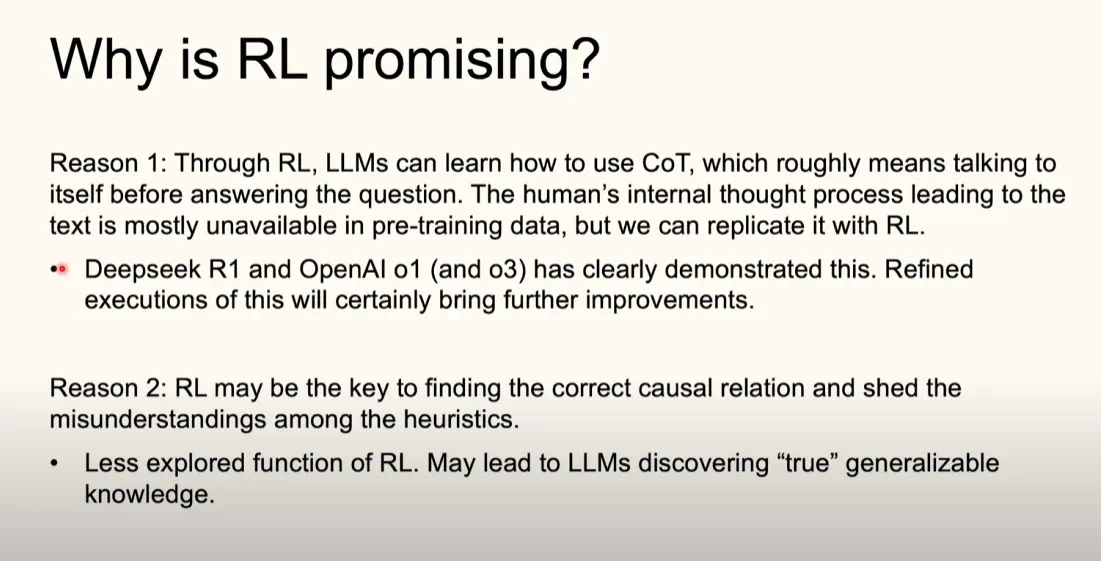
My reading of Zhang’s hypothesis is that much of the reasoning pattern is already present in pre-training, and post-training helps elicit it. I do not take this as proof that post-training can introduce NO NEW KNOWLEDGE. RL simply does a better job of eliciting EXISTING PATTERNS (like CoT) from pre-training, and the “aha moment” words (like “wait…”) are common phrases in high-quality math discussion data. When combined with test-time compute, which allows models to dynamically leverage more tokens on “thinking paths” with higher success rates, and also to adapt from previously wrong choices.
My intuition is that:
- Instead of slamming hard on tokens that have a multimodal nature and non-reducible variance, we should supervise on thinking circuits
- RL is a better way (than SFT) to search and elicit existing patterns
- In layman’s terms, RL explores better solutions from the model’s point of view and helps the model develop a better “intuition” in the solution space instead of the token space
Update: I found this fascinating explanation of WHY RL works14
4. The path to reasoning with images
OpenAI’s O3 is a living testament15 that reasoning with images is possible. If you haven’t seen it, be sure to watch it—truly special, even magical.
Just to be clear, O3’s image implementation is still largely UNKNOWN.
Zhang’s insight is that it PROBABLY can be traced back to pre-training as well:
- There are lots of explanation patterns for images
- These patterns often involve annotation or simply zooming to regions of interest, e.g., fixing electronics, labeling the special usage of tools, etc.
- O3’s thinking patterns can be seen as successful elicitation of cropping/zooming/annotation patterns
- As a side note, image manipulation is implemented with live coding in Python ; though I think more structured, parameterized function calls would be more appropriate.
Sources & further reading
References
- Why Next-Token Prediction Could Surpass Human Intelligence: video ↩
- https://podwise.ai/dashboard/episodes/4209997 ↩
- Unverified recollection: I have not identified the original talk or speaker, so this is not a verified attribution. ↩
- VideoMAE: Masked Autoencoders are Data-Efficient Learners for Self-Supervised Video Pre-Training: https://arxiv.org/abs/2203.12602 ↩
- SigLIP 2: Multilingual Vision-Language Encoders with Improved Semantic Understanding, Localization, and Dense Features: https://arxiv.org/abs/2502.14786 ↩
- Perception Encoder: The best visual embeddings are not at the output of the network: https://arxiv.org/abs/2504.13181 ↩
- EVA-CLIP-18B: Scaling CLIP to 18 Billion Parameters: https://arxiv.org/abs/2402.04252 ↩
- Related evidence on resolution and representation trade-offs: Perception Encoder, https://arxiv.org/abs/2504.13181. This paper does not establish that resolution matters more than model size in general. ↩
- Inverse Scaling: When Bigger Isn’t Better: https://arxiv.org/abs/2306.09479 ↩
- Inverse scaling can become U-shaped: https://arxiv.org/pdf/2211.02011 ↩
- https://www.jasonwei.net/blog/common-arguments-regarding-emergent-abilities ↩
- SFT Memorizes, RL Generalizes: A Comparative Study of Foundation Model Post-training: https://arxiv.org/abs/2501.17161. Its results concern the tested rule and visual variants, not a universal law about SFT. ↩
- DeepSeek-R1: Incentivizing Reasoning Capability in LLMs via Reinforcement Learning: https://arxiv.org/abs/2501.12948 ↩
- [UCLA RL-LLM] Chapter 0: Course outline and prologue: https://www.youtube.com/watch?v=q9972BRoXzQ ↩
- https://simonwillison.net/2025/Apr/26/o3-photo-locations/ ↩